Open 24 X 7 | drrajeshranjan447@gmail.com

Bladder stones form when urine sits in the bladder for too long — most often because of an enlarged prostate or a narrowed urethra. Dr. Kumar Rajesh Ranjan, M.Ch (Urology), removes bladder stones with laser cystolithotripsy through the urine passage and treats the cause in the same plan, so the stones do not come back.
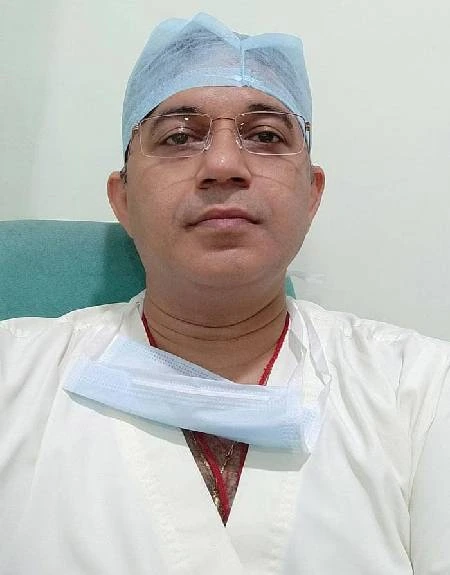
Most urinary bladder stones are removed by cystolithotripsy: a cystoscope is passed through the urethra into the bladder and a holmium laser or lithotripter breaks the stone into fragments that are washed out, with no cut on the body. Very large stones may need a small keyhole (percutaneous) or open approach. Because bladder stones usually form due to poor bladder emptying, the cause — such as an enlarged prostate or urethral stricture — is treated at the same time. In Patna this is done by M.Ch urologist Dr. Kumar Rajesh Ranjan at Satyadev Super Speciality Hospital.

Bladder stones are hard lumps of minerals that form inside the urinary bladder. They are different from gallbladder stones, which form in the gallbladder near the liver and are treated by a general surgeon.
In adults, bladder stones usually mean the bladder is not emptying fully. The commonest reason in men over 50 is an enlarged prostate (BPH); others include a narrowed urethra (urethral stricture), a weak bladder after spinal or nerve problems, and long-term catheters. Sometimes a kidney stone travels down and grows in the bladder.
Removing only the stone without fixing the reason for poor emptying often leads to new stones, so Dr. Ranjan checks the prostate, urethra and bladder function before planning surgery.

Some bladder stones cause no symptoms and are found on ultrasound. Others cause these problems:
Pain above the pubic bone, sometimes felt at the tip of the penis in men.
The stone blocks the bladder outlet mid-stream; changing position may restart it.
Especially at the end of urination or after movement.
⚠ Always needs evaluationBurning, urgency and getting up at night to pass urine.
Stones harbour bacteria, causing infections that keep coming back.
A large stone or enlarged prostate can block urine completely. Call +91-8050295197.
🚨 Emergency — call immediatelyThe method depends mainly on stone size, the patient's age and whether prostate surgery is done at the same time.
| Feature | Transurethral Cystolithotripsy | Percutaneous Cystolithotomy | Open Cystolithotomy |
|---|---|---|---|
| Access | Through the urethra — no cuts | Small keyhole in the lower belly | Incision in the lower belly |
| Best for | Most bladder stones | Very large stones or narrow urethra | Very large stones with other open surgery |
| Combined with prostate surgery | Yes, same sitting | Possible | Possible |
| Hospital stay | About 1 day | 1-2 days | 3-5 days |
| Recovery | Quick | Quick | Slower |
A step-by-step guide to laser cystolithotripsy at Satyadev Hospital.
Ultrasound or CT shows the stone size. Flow test, PSA (in men) and urine culture find the cause and any infection.
Before surgerySpinal or general anaesthesia.
10-15 minutesA telescope is passed through the urethra into the bladder to see the stone.
First few minutesA holmium laser breaks the stone into small fragments, which are flushed out of the bladder.
20-60 minutes, depending on sizeA catheter drains the bladder briefly. Most patients go home the next day.
Usually 1 night
Recovery is quick after the transurethral approach.
Catheter for a short time. Walking the same day.
Mild burning and a little blood in urine are normal.
Back to routine activities for most people.
Follow-up with ultrasound and flow test.
Treating the cause and drinking enough water prevent new stones.
Call +91-8050295197 and come to Satyadev Hospital for any of these.
Needs a catheter urgently.
Clots can block the bladder.
May indicate a serious urine infection.
With a swollen, full bladder.
With swelling or breathlessness.
Possible blood infection (urosepsis).
Results in urology depend on the surgeon's training and the equipment available. Here is what you get at Satyadev Urology.
MBBS, MS, M.Ch (Urology), FMAS, with fellowship training in advanced laparoscopic urology and kidney transplant at Urocare, Kochi and Aesculap Academy, Germany.
Holmium laser, flexible ureteroscopes, C-arm fluoroscopy, HD laparoscopy and modular operation theatres in one hospital.
Recipient of the Stars of Bihar Award, the Acharya Charak Medical Award and Icon of Health, Bihar.
Round-the-clock critical care and anaesthesia support for high-risk and emergency patients.
Cashless treatment for eligible patients under Ayushman Bharat PMJAY and most major insurers and TPAs.
Consultation, CT and ultrasound, lab tests, surgery and follow-up under one roof — no need to travel to Delhi or Vellore.
11:00 AM – 3:00 PM, Monday to Saturday. Consultation ₹800, valid for 15 days.
3:00 PM – 4:00 PM, Monday to Saturday. Sunday OPD closed; emergency open 24×7.
Old prescriptions, scan and blood reports, and a list of your current medicines, especially blood thinners.
Read the full profile of Dr. Kumar Rajesh Ranjan, urologist in Patna, his doctor profile at Satyadev Hospital, or the hospital OPD timings.
Treatment for enlarged prostate and urine blockage.
Lasting repair of urethral stricture.
All options for kidney stones: RIRS, PCNL, URSL and medicines.
Laser removal of stones stuck in the ureter.
Urology care for babies and children.
What decides the cost and how Ayushman Bharat helps.
"One of the best doctors for kidney problems in Patna. All advanced procedures like PCNL, URS, laparoscopic nephrectomy done here. Clean and hygienic."
Rajan Sharma"Dr. Kumar Rajesh Ranjan ne clearly samjhaya ki darne ki koi baat nahi hai aur treatment possible hai. Mera operation yahan successfully hua. Ayushman Bharat card se treatment ho gaya."
Ajit Thakur"Bahut bahut dhanyawad sir. Kisi bhi tarah ki dikkat nahi hui. Yahan mera bacche ka ilaj bahut hi bdhiya dhang se hua hai."
Rupesh PaswanAnswered by the urology team at Satyadev Hospital, Patna.
Bladder stones are treated by a urologist. Dr. Kumar Rajesh Ranjan, M.Ch (Urology), at Satyadev Super Speciality Hospital, Patna, removes bladder stones with laser cystolithotripsy and treats the cause, such as an enlarged prostate, in the same plan.
No. Bladder stones form in the urinary bladder and are treated by a urologist. Gallstones form in the gallbladder near the liver and are treated by a general or laparoscopic surgeon.
Rarely. Only some uric acid stones may dissolve with medicines. Most bladder stones need to be removed, and the cause of poor bladder emptying needs treatment.
In most cases, yes. Laser cystolithotripsy is done through the urethra with no cuts. Very large stones may need a small keyhole or open approach.
They can if the cause is not treated. Treating an enlarged prostate or stricture and drinking enough water greatly reduce the chance of new stones.
Yes, for eligible patients at Satyadev Super Speciality Hospital, along with CGHS, ESIC and most insurance TPAs.
नीचे पेट में दर्द, पेशाब बीच में रुक जाना, पेशाब में खून, बार-बार जलन वाला पेशाब और बार-बार इन्फेक्शन इसके आम लक्षण हैं।
ज़्यादातर मामलों में पेशाब के रास्ते से दूरबीन डालकर लेज़र से पथरी तोड़कर निकाल दी जाती है। कोई चीरा नहीं लगता और मरीज आमतौर पर अगले दिन घर चला जाता है।
Call +91-8050295197 or +91-8235152796, or use the contact page. New patients are seen 11 AM to 3 PM, Monday to Saturday.
Laser cystolithotripsy and treatment of the underlying cause, under one roof in Patna. Call now or visit us at Magistrate Colony, Khajpura, Patna.
Book an Appointment